


During these challenging times, I turn to music for comfort, motivation, and passion.
As a child of the 60’s Pete Seeger’s “If I had had a hammer,” popularized by Peter, Paul, and Mary, immediately comes to mind
Bruce Springsteen’s new The Streets of Minneapolis has become a ballad of resistance and now tops the pop charts. A great anthem from the “boss” about the presidential “pretender” in the White House.
I was delighted to hear another great tune from the Country genre performed by Tim Grimm at a bar in Texas. https://www.facebook.com/reel/1619707135692603
I love the lyrics and steel guitar.
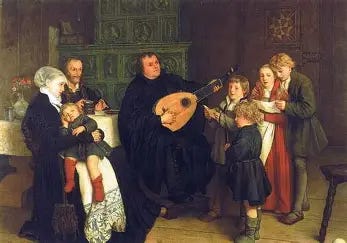
The theologian Martin Luther rediscovered “grace,” and his composition “A Mighty Fortress is Our God” transformed the world of the Middle Ages.
He said, “When we sing, we pray twice.”
What is it about music that “moves” us? As a poet I affirm that words can have an enormous affect. Elizabeth Barret Browning’s classic question comes to mind with Valentines Day approaching. “How do I love thee? Let me count the ways. I love thee to the depth and breadth and height…”
Equally important for me is the visceral aspect of music. Visceral describes deep, instinctive and emotional reactions that are felt in the gut rather than thought out rationally.
I suspect that is why I love the cinema and am deeply moved by the music of the movies.
John Williams theme for Shindler’s List captures the deep sadness of the Holocaust and reignites my love for my Jewish friends and their struggles. Here’s Itzhak Perlman’s violin touching our hearts.
Ennio Morricone’s theme song, Gabriel’s Oboe, from the The Mission shares the compassion (suffering with) of two Jesuit priests in the 18th century to save their mission and its Indian inhabitants from the pragmatic Roman Catholic Church and ruthless Spanish and Portugese slave traders.
Music and all the arts are a powerful force for good, which despite current reduction of support from our government, continue to move us to action.
Theologian friend, Daniel Erlander, challenged the false belief in Coercive Power. He and I believe that the way of “Redemptive Suffering” is the way to true and lasting change and its “pathos” stirs our souls. This hymn is a moving example.
O God of Earth and Altar
Bow down and hear our cry
Our earthly rulers falter
Our people drift and die
The walls of gold entomb us
The swords of scorn divide
Take not thy thunder from us
But take away our pride
From all that terror teaches
From lies of tongue and pen
From all the easy speeches
That comfort cruel men
From sale and profanation
Of honour and the sword
From sleep and from damnation
Deliver us, good lord
Tie in a living tether
The prince and priest and thrall
Bind all our lives together
Smite us and save us all
In ire and exultation
Aflame with faith and free
Lift up a living nation
A single sword to thee
~G.K. Chesterton 1906
During the Pandemic I did a number of Podcasts with musician friends (folk, rock, hip-hop, choral, orchestral, jazz) who told the stories of how they were called to a life of making music, followed by examples of their art. The series is called the Magic of Music. Here’s the link:
For more information about my books, films, podcasts and to book speaking engagements, check out paddle-pilgrim.com
I had an Old Testament/Hebrew professor once ask, rhetorically, how Miriam could "get away" with her words celebrating the slaughter of the pursuing Egyptians. And he answered, "She didn't say it. She sang it. There is a lot of latitude with singing." Music speaks at a level other than mere philosophical parsing of words and sentences...and touches something quite true and quite real. I will be playing Bruce's tune every January 7th and 24th, like I play Neil's song every May 4th. Dave, thank you for your continued embrace of life.